Department of Computer Science
Specialisations in the Bachelor's degree programmes in Computer Science (BI) and Business Information Systems (BWI)
Bachelor of Computer Science
Cyber Physical Systems
What is it about?
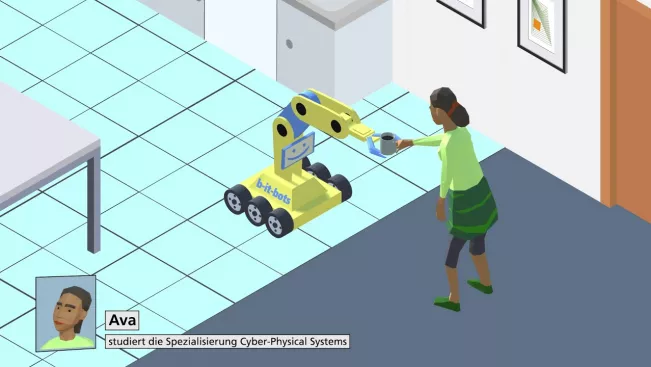
Networked computer systems (cyber) operate in our environment (physical) and are increasingly taking on tasks that make our lives easier. This specialisation focuses on the design of computer systems that are embedded in a technical environment, from smart homes to autonomous robots.
Which courses do students take?
(Course examples)
- Android Robotics Project
- Architecture of Embedded Systems
- Digital Signal Processing
- Embedded C++
- Robots and Autonomous Systems
- Smart City: Sensors and Networks
What is special about this specialisation?
Cyber Physical Systems are characterised by their connection to the real world, which means that this specialisation is closely linked to engineering. The specialisation is aimed at students who are interested in the technical aspects of computer science, especially when it comes to making things happen with software. A basic interest in microcontroller technology, electronics and/or mechanics is recommended.
Contact persons
Explanatory film Specialisation Cyber Physical Systems
Data Science
What is it all about?
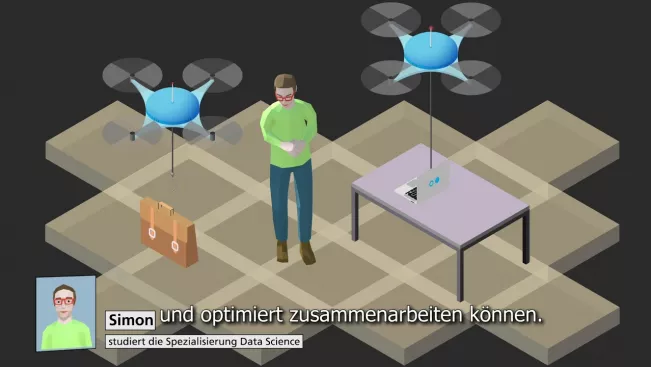
Data Science is about gaining knowledge from data. This data is analysed in order to discover previously unknown, useful correlations and thus make better decisions.
What courses do students take?
(Course examples)
- Data Science: Mathematical and Algorithmic Fundamentals
- Data Analysis and Visualisation
- Basics of Machine Learning
- Artificial Intelligence and Machine Learning
- Modern Data Warehouse Architectures as the Basis for Big Data
- Numerical Methods for Data Analysis
- Data Analysis Project
What is special about this specialisation?
This specialisation is particularly concerned with mathematical relationships and complex algorithms.
Contact persons
Explanatory film Specialisation in Data Science
Information Security
What is it about?
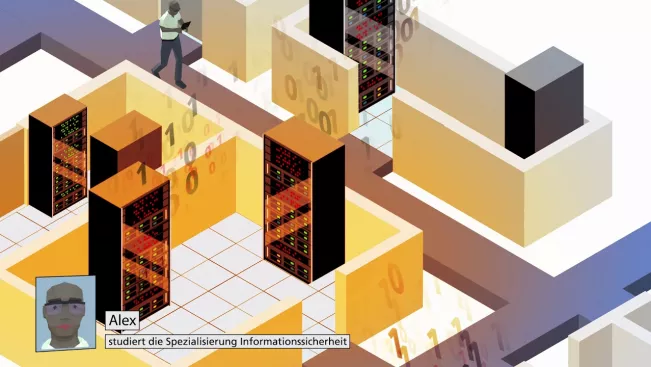
Information security is the science of protecting information and resources against intelligent attackers. This includes both the technical procedures of IT security (e.g. cryptographic protocols, authentication procedures, platform security solutions in hardware and software) and the organisational measures of IT security management in companies.
Which courses do students take?
(Course examples)
- Applied cryptography
- Digital forensics
- Identity management and PKI
- Network security
- Security of web applications
- Topics of information security management
What is special about this specialisation?
Students should have an interest in programming and system administration, as this specialisation involves a lot of practical work on computers.
Contact person
Explanatory film Specialisation in information security
Complex software systems
What is it about
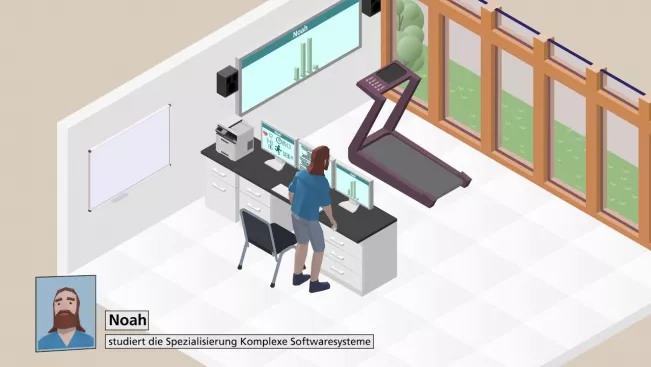
The specialisation deals with the software development of complex application systems.
Which courses do students take?
(Course examples)
- Cloud Computing
- Database Systems Engineering
- Introduction to Web Engineering
- Introduction to Geoinformatics
- Integration Architectures
- Human-centred Design
- Programming Parallel Applications
- Programming Languages
What is special about this specialisation?
The specialisation is one of the most popular and offers a wide range of topics. Students have access to commercial software products and a high-performance computer cluster.
Contact persons
Explanatory film Specialisation in complex software systems
Networks and virtualisation
What is it about?
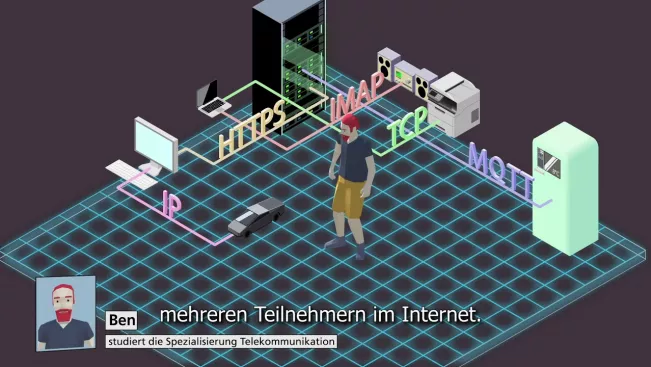
The Networks and Virtualisation specialisation covers the processes, protocols, technologies and network structures that enable today's diverse communication applications and services, some of which access globally distributed servers.
Which courses do students take
(course examples)
- Cluster infrastructures and virtualisation
- Intelligent networks and virtualisation
- Transport and high-speed networks
- Virtualisation and containerisation
What is special about this specialisation?
It deals with basic processes and structures that are used countless times every day by every private individual and in every company and that now underlie almost every commercial interaction.
The proximity of many telecommunications companies based in the Bonn region, such as Deutsche Telekom and others, offers students the opportunity to learn about the latest technologies. deutsche Telekom and others offer students not only a great deal of practical relevance but also a wide range of employment opportunities in the surrounding area.
Contact persons
Explanatory film Specialisation in networks and virtualisation
Visual Computing
What is it about
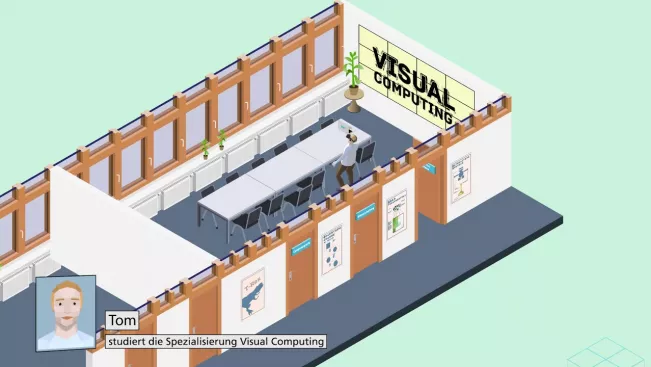
The specialisation deals with the information technology areas of image acquisition (image acquisition), the processing and analysis of image data (image analysis) and the generation of images (image synthesis).
Which courses do students take?
(Course examples)
- Current topics Visual Computing in Application
- Computer Graphics
- Data Formats for Interactive Media
- Game Development 1
- Game Development 2
- Basics of Image Processing
- Interactive Environments
What is special about this specialisation?
Students have access to state-of-the-art laboratories with various interactive display systems, such as head-mounted displays (HMDs), AR glasses and display walls. There is also a direct link to research projects.
Contact persons
Explanatory film Specialisation Visual Computing
Bachelor of Business Information Systems
Cluster: Integrated Business Systems
What is it about?
The Integrated Business Systems cluster deals with the integration of internal and cross-company application systems.
Which courses do students take?
(Course examples)
- Business process management
- Integrated business information systems
- Cross-company business information systems
What is special about this cluster?
Students should enjoy modelling/programming and be interested in implementing complex business structures. There is the opportunity to work hands-on with an SAP Enterprise Resource Planning System.
Contact persons
Overview of the specialisation presented by Prof. Dr. Andreas Hense.
Cluster: Integrated Business Systems in the BSc Business Informatics programme
Cluster: Business Data Analytics
What is it about?
The Business Data Analytics cluster deals with systematically analysing data and deriving well-founded business decisions from it by combining methods from data analysis, statistics, computer science and business administration.
What courses do students take
(course examples)
- Business Data Analytics - Case Studies
- Data Engineering and Data Management
- Modern Concepts of Data Management
What is special about this cluster?
Students should have an interest in business contexts and their representation in technical systems.
Contact persons
Cluster: Entrepreneurship and digitalisation
What is it all about
The Entrepreneurship and Digitalisation cluster is about developing innovative business ideas and using digital technologies in a targeted manner to found, shape and successfully manage companies.
What courses do students take?
(Course examples)
- Digitalisation
- Entrepreneurship and start-ups
- Operative and strategic IT controlling
What is special about this cluster?
This cluster has a stronger business focus. One focus is the founding of start-ups.
Contact persons
In the respective curriculum you will find an up-to-date overview of the courses offered as well as the corresponding module descriptions for the courses in the specialisations and clusters